Showing posts with label archaeology. Show all posts

Saturday, May 12, 2012

Much delayed...

When I lived in Israel in 2010, there were two things that were promised to be opened shortly: the newly renovated Israel Museum and the Light Rail.  The Museum had been closed my entire 2 years in Israel, and the renovations had taken longer than planned.  The Light Rail was at least 2 year delayed in its opening.  Thus, these two things I should have been able to experience were still closed when I left in July of 2010.  And, of course, they both opened shortly after I left.  Such is life.

Fortunately, I managed to get back to Israel, and this week I rode the Light Rail and went to the Israel Museum, all in one day.

Campus was mostly empty this week, but one of the students and I decided that the Israel Museum needed to be visited.  And, unsure of the bus system, we decided to take the Light Rail.  It doesn't really drop one off really close the museum, but the walk isn't bad.  We ended up walking the whole way home, which didn't take much longer...but the Light Rail was an experience worth having.

Riding down Jaffa Road

Here we're crossing the famous bridge.  Whether you like it or hate it, it's quite a landmark in Jerusalem.
Once at the museum our excitement was great.  One of the first things we saw was this:

The original four-horned altar from Beersheva.  Probably dismantled and put to secondary use during the reforms of Hezekiah (or a similar Judean King), it was found and reassembled by archaeologists, and sent to Jerusalem.  

Objects from the "Cave of the Treasure" were also displayed, including this intricate scepter.  All these things date to the Chalcolithic Age.

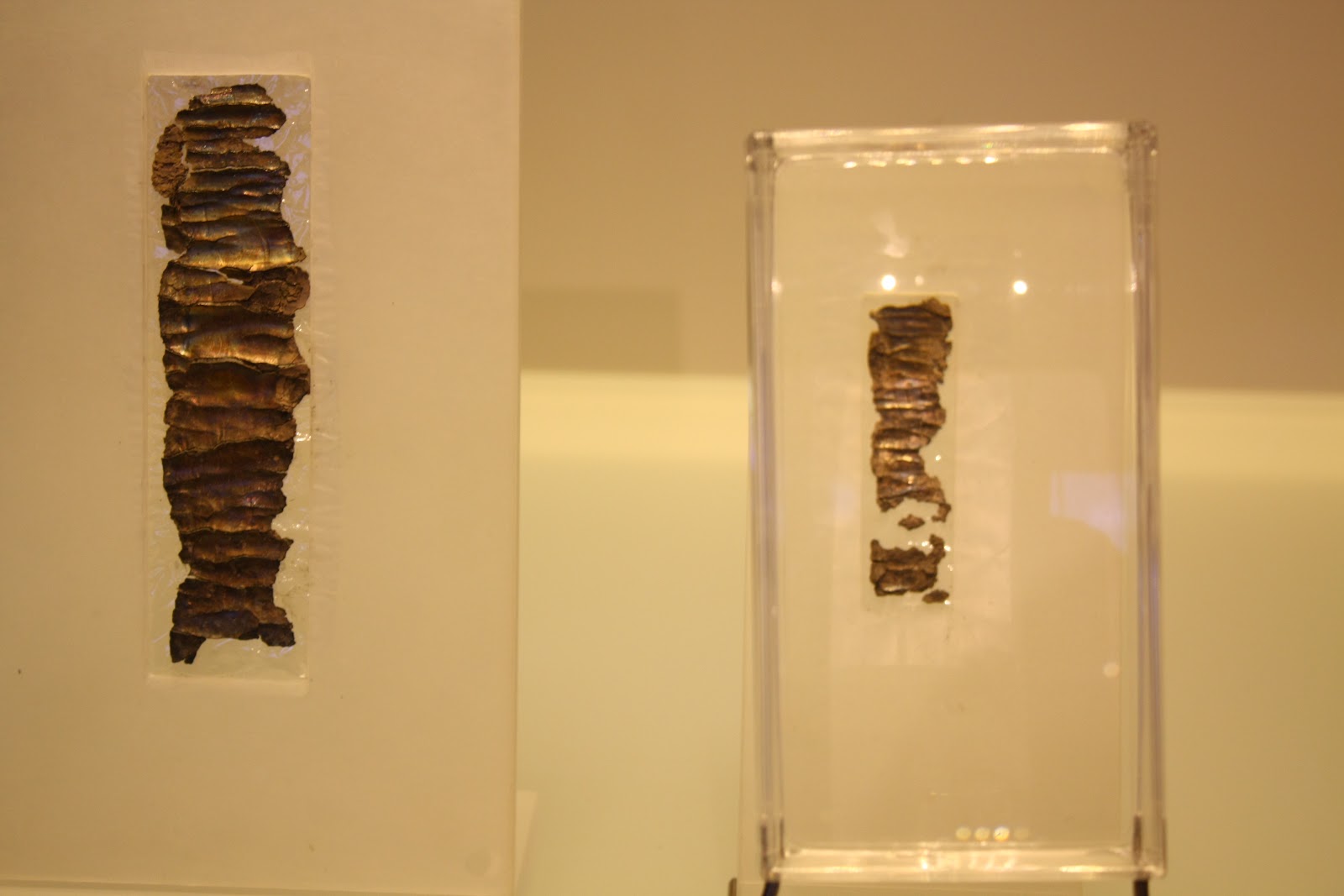
There were many archaeological finds that excited my interest, but perhaps one of the coolest to finally see was this one:
I know it doesn't look like much, but it was found just across the valley from JUC at Ketef Hinnom by my very own archaeology professor, Dr. Gabi Barkai.  These two small silver scrolls contain the oldest known text of Hebrew scripture (the priestly blessing from Numbers 6)- considerably older than the Dead Sea scrolls.  

One of the prettiest displays was the ancient glass room.  I especially liked that little bottle on the bottom.  So brilliantly colored.

There are other wings to the museum, aside from the all important ancient history/archaeology wing.  There's sections for Africa, Asia, the Pacific Islands, and the Americas.  Yes.  I came all the way from Montana where there ARE American Indians to see this display in Israel about American Indians.

We finished off the visit with a look around the Second Temple Model of Jerusalem (which I HAD seen before).  See that wall in the picture below?  The section with two towers and then, a little ways down, a small gate?  That's where JUC is now.  If my understanding is correct, our office is actually on top of the remains of one of those towers.  And the remains of that gate, possibly the gate of the Essene, those remains are in our cemetery.  As you can see the Temple and other important remains in the background, you can get a feeling for how close to everything we are here.

I'll try not to bore you with any more details of pottery and statues and swords and arrowheads and...  Yeah, very cool stuff.  Come visit me and I'll show you. :)


Wednesday, June 1, 2011

Istanbul!

There came a breaking point.  A point where we said, "Enough is enough!"  A point when we rolled up our bedrolls, saddled our horses, and rode into the sunrise. 


When we arrived in Istanbul after taking a night bus out of Thessaloniki, there was great rejoicing.
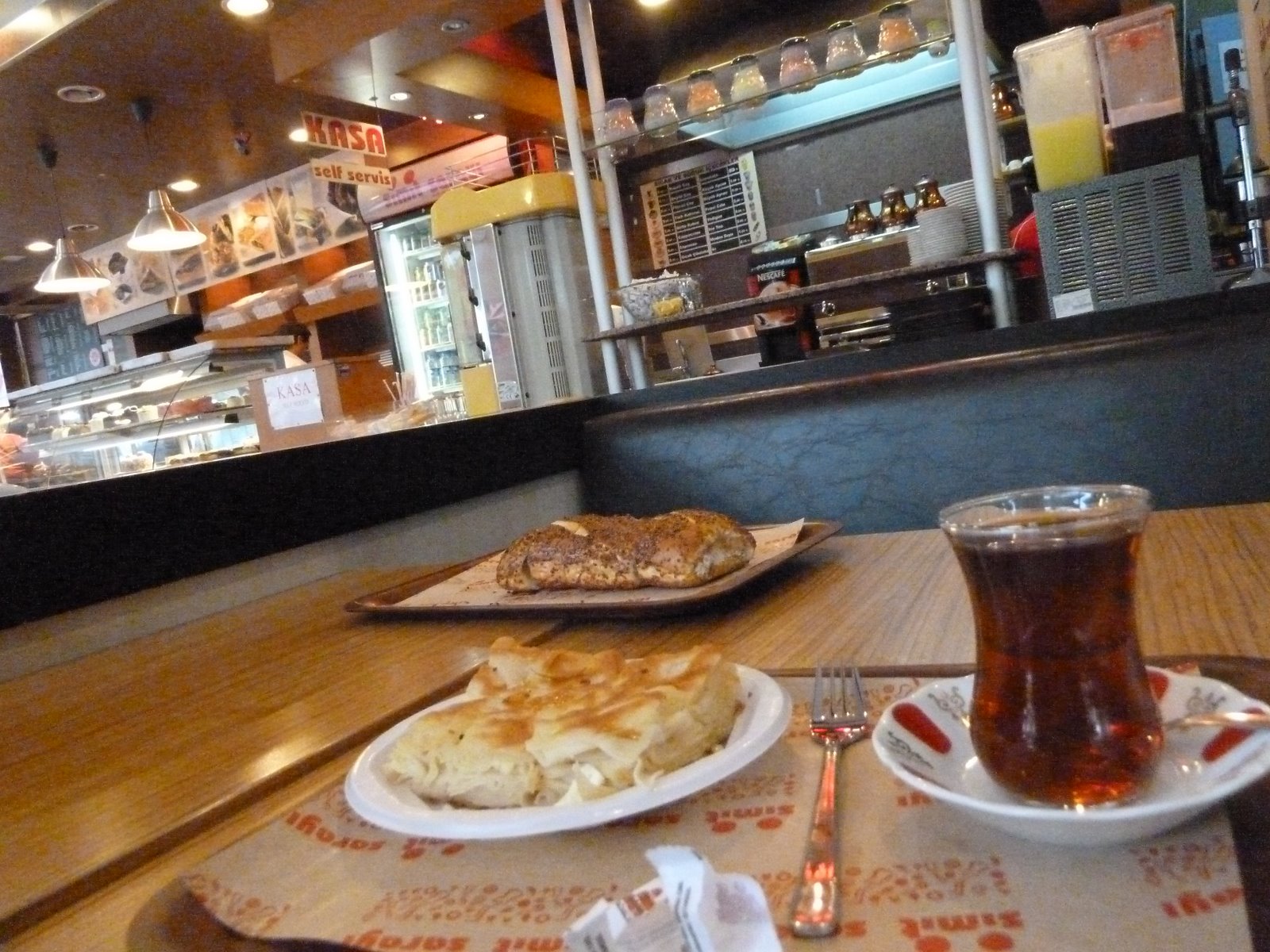
And we had food and tea to celebrate.  

We had a little trouble figuring out the metro system, but helpful people seemed abundant, and soon we came to Sultanahmet and to our hostel with this window view:
Yes, that is Hagia Sophia.  Rough life?  Yes.  
After a long night on the bus we took it pretty easy that day, just strolling around a little, but not trying to see any major sites.


After a good nights rest, Wednesday morning we were ready to go.  

We first headed to Topkapi Palace, only to discover that the line was longer than a lightyear (well, not really, but it was long) so we diverted our plans and went first instead to the Archaeological Museum.  

I may as well tell you right now, so you are not under any false impressions, that I am a total geek and that visiting the Istanbul Archaeological Museum has been a dream of mine for a while now.  I blame Gabi really.  He would tell us about some interesting find from somewhere in Israel and then say, in his thick accent, "That is in the museum in Istanbul."  Basically, it was an exciting day for me.

While there were many fun and exciting things to see (and many less fun and exciting things - I find that sarcophagi and gravestones get repetitive after a while), one of the most exciting for me was to finally see the original inscription from Hezekiah's tunnel:
I know, it's not much to look at, but that's ok.  It was cool. :)

Among many other famous things, we also saw the sarcaphogus of Alexander the Great.

After a lunch of peanut butter and nutella sandwiches (finding peanut butter = another exciting event in Turkey) we decided to try the palace again, this time with better luck.

It was an interesting experience.  The treasure rooms still display some of the wealth of the Ottomans and are packed with people, ogling at the jewel encrusted swords and lamps, rings the size of two of my fingers, and a diamond not much smaller than my fist.  Who knew that so much wealth existed?


The portrait room displays paintings of the various sultans, like any proper landed family in England displaying their ancestors.

They also have a room with the Sword of the Prophet David, the Staff of the Prophet Moses, the hand and head of John the Baptist, and several hairs from the Beard of the Prophet.

With all that, I think I still liked the garden best.

It was strange, but everything - the towers and turrets, the family portraits, the treasure rooms and jewel-encrusted whatever reminded me more than I expected of fairy tales and stories of European royalty.  I suppose I shouldn't have been surprised, but they were more similar than I expected - just with a few twists, here and there.

A meal on a rooftop was a good way to conclude the day, with the sun setting over the city,
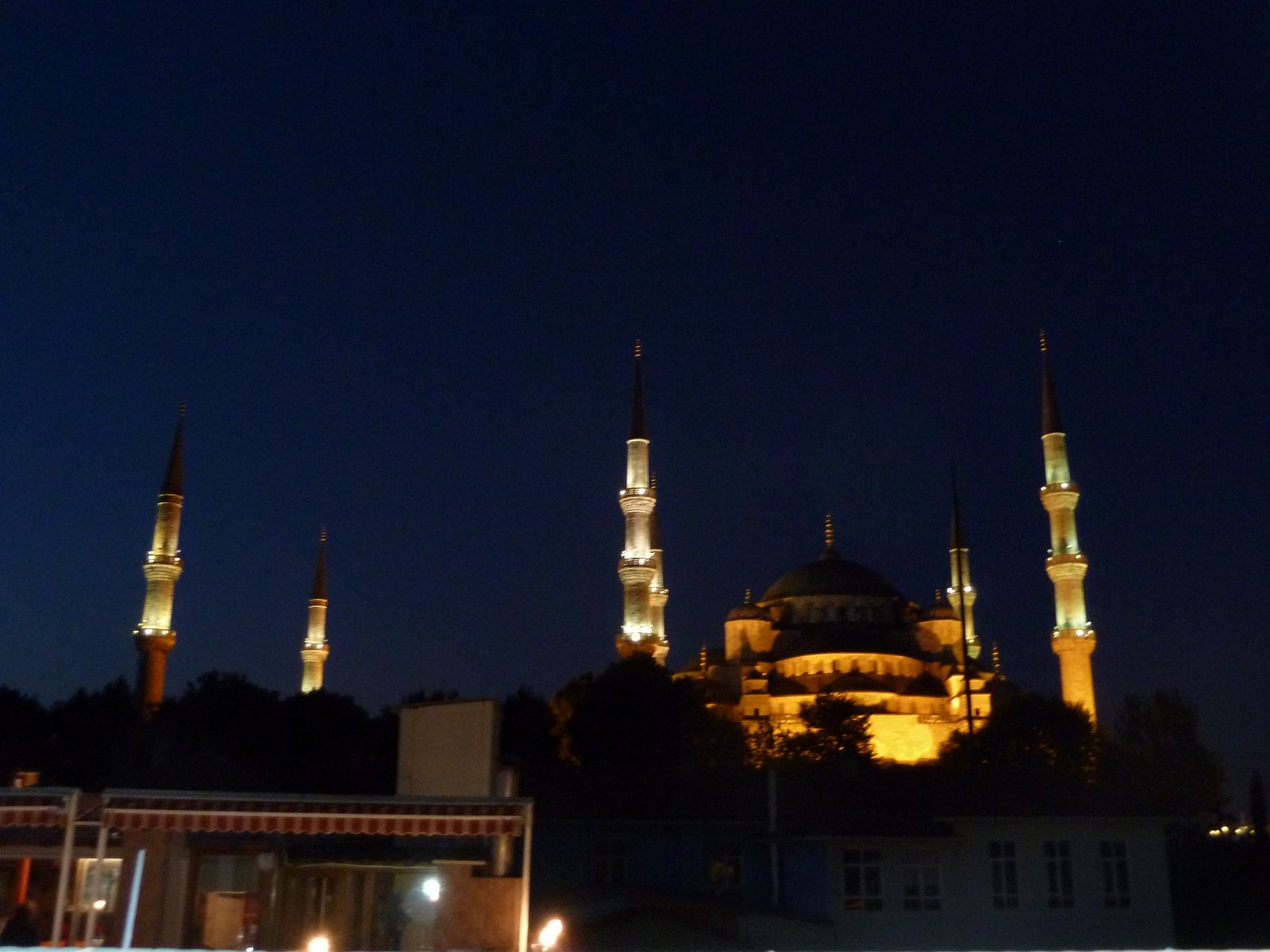
and the Blue Mosque lit up for the night.


Yeah, Istanbul is pretty cool.  

Thursday, March 4, 2010

Historical Rights

I was perusing head lines in the Jerusalem Post today when I came across this quote (from this article):

"You don’t have to be a biblical scholar to recognize the incontestable Jewish nature of Rachel’s Tomb and the Cave of the Patriarchs."

Yes, actually, such recognition might flow much more easily if one is, in fact, not a biblical scholar.

Let me back up a little. Recently, Rachel's Tomb (in Bethlehem) and the Cave of the Patriarchs (in Hebron) were placed on Israel's list of Heritage sites. There are generally two responses to this action.

The first reaction is the one taken by the Palestinians, and much of the rest of the world. This is a political move to attempt to claim more Palestinian land for Israel and should not be tolerated.

The other reaction is the one taken by the author of this article. Historically speaking, the Jewish people are connected with the Old Testament and the stories of the patriarchs, Abraham, Isaac, and Jacob. The Bible records the burial of Rachel near Bethlehem and the burial of Sarah and various other members of that family near Hebron. As these are the tombs of their ancestors, they should clearly have the right to revere them.

A lot of the question comes down to Historical Rights. Everyone in this land who tries to claim it bases their claim in history. In recent history, Palestinian refugees claim houses in Israel (currently occupied by Jewish Israelis) as their ancestral homes, where the lived until 1948. Looking at more ancient history, Jews claim Jerusalem as their capital, citing it's defeat by King David 3000 years ago. In return, Palestinians claim Jerusalem, claiming to be descendants of the Jebusites who controlled it before David. Does history give rights in the present day? And if so, what layer of history do you choose?

The author mentioned above continues his argument, trying to emphasize that the Jewish layer of history predates that of all other claimants, and therefore is the one that counts:

"Sites such as Rachel’s Tomb and the Cave of the Patriarchs are part of the national and religious patrimony of the Jewish people, and we do not need anyone’s permission to renovate and maintain them. Our reverence for these sites and attachment to them predates Muhammad and precedes Jesus, and no one has the right to lecture us about where and how we choose to serve God."

There is, however, a bit of a problem with his argument.

Let's start by looking at the Cave/Tomb of the Patriarchs. To quote Ehud Netzer from The Architecture of Herod, the Great Builder, "To the present day there is a general consensus among scholars that this structure in Hebron, which is well preserved and perhaps even intact, was built by Herod [the Great]." Admittedly, Herod does still precede Jesus and Mohammed, but not by much. Of course, the fact that this structure was probably built by Herod does not mean that it is not built on top of the Tomb of Machpelah. Tradition may have preserved the actual site, and Herod may have built on top of it, trying to please the Jews. Or, maybe, Herod just built on a random cave with no connection to the Patriarchs. It's hard to say how much validity the Jewish claim to this site has, at least in the ancient past. We'll let it pass for now and move on to Rachel's Tomb.

Rachel's Tomb, clearly of relatively modern Islamic construction, is a sheik's tomb. Again, there is a possibility that it was built on top of the site of Rachel's tomb, but in this case the archaeological connections are even more uncertain.

So do the Jews have the right to claim these sites as heritage sites? Maybe, maybe not. Within more recent history, these sites have probably been revered by the few Jews living in the land for over 1000 years. I know less about modern history, but at the very least, they have apparently been revered for the last 100 years. Does this give them a right?

I'll leave that for you to ponder. I have no easy answers.

I would really like it, though, if people claiming historical rights would check their historical facts.

Tuesday, May 19, 2009

Chapter 1: Wherein the author details the start of her adventure in Jordan

Saturday, May 9, 2009

We were on the bus by 7am and made our way to the Allenby crossing. We made it out of Israel and into Jordan with minimal trouble, met our guide and Jordanian tourist policeman and made our way east and south to the top of Wadi Dana (pronounced like Donna). They have the second largest nature preserve in Jordan and are working hard to be eco-friendly. They have a collection of all the plants and animals that live on the reserve (like bug collections and a herbarium and all). That was really cool. I wish I could have seen everything, but there were too many people and we didn't spend much time there. It was a very exciting day for me, though. It's pretty much the only field study I've been on where any attention was paid to science of any sort (except some geology), so the biological factor of this day was especially fun. After that we drove to the camp, moved into our tents, and ate a rather odd lunch. It contained more "typical" food like flat bread with spices, goat's cheese, cucumbers, and a tomato, but it also had a juice box and a snack cake. Oh, Jordan. I think, though, that it was the first time I've ever eaten a whole tomato. I still wouldn't say they're my favorite food, but I've grown accustomed to them over the last year.

After lunch we took a nature walk - more science, yay! Our guide had grown up hunting in this area, but is now determined to protect the animals. He told us about the medicinal uses of various plants and found a couple scorpions for us to see. Very exciting. It kind of reminded me of the nature walks I used to do with campers, except the most exciting thing I showed them was how to eat ants. No scorpions at camp.

We threw my frisbee around for a while before dinner. It will be a widely travelled frisbee. Dinner was outside after dark. They had a bit of a shelter and a few lamps, but it was nearly impossible to see what we were eating. Oh well, it was pretty tasty and I suffered no ill effects. After dinner we hung out in the bedouin tent, drinking gallons of bedouin tea, talking, and playing games.

It was a fairly chilly night, but our tents were well provisioned with blankets, so I slept quite well.

Sunday, May 10, 2009

The next morning we breakfasted and rode back to the bus and then back to Dana village to begin our decent down Wadi Dana. I would estimate it was probably 6-8 miles. A nice walk, but not too strenuous, especially because it was downhill. However, if it were in the heat of summer, uphill, in full battle regalia (like Judah and Israel in 2 Kings 3), well, it would be a bit exhausting, and frightening.

It was, however, a beautiful walk. The sandstone/granite formations were beautiful and the oleander were blooming, what more could you want? I spent much of the walk listening to people more knowledgeable than I converse about various issues involving Israel, Palestine, the eastern church, and various related theological questions. It was quite enjoyable.

We arrived at the Feynan Eco-Lodge around 3, got our rooms, and were amazed by their luxury. However, we didn't take the time to relax just then. Instead we hoped on some "jeeps" and drove to the copper mines of Tom Levy's excavation. (Note: they seem to call every small 4-wheel-drive type vehicle a jeep. These were actually Toyata trucks, and we got to ride in back. Best day ever.) Many of these mines date back to around the 10th century BC. Copper mines. Perhaps they are the famed copper mines of King Solomon? They were fun to visit anyway. We also paused at the site of Feynan castle. Fun story about that place...ask me sometime. :)

The rest of the day was spent at the lodge, enjoying hot showers, playing mafia, eating amazing food by candle-light, and watching the stars. So far, so good.

Sunday, March 15, 2009

Archaeology of Jerusalem...

March 15, 2009

Today we had yet another field study, this one for Archaeology. We were going to look at the Southern Wall excavations, but due to the rain, we headed instead to the Wohl Museum. This is another place that I had been to on my first visit to the city and hadn't yet re-visited. I don't remember much about my first visit, but I have no doubt that we were given more information this time around. :)

From the late 40's to the early 60's the Jewish quarter in the old city was under the control of the Jordanian government and by the time it was re-take by the state of Israel in the 60's, much of it had been destroyed. Some of the buildings were at least partially salvageable, but many were only rubble. These later buildings were cleared away in preparation for re-building. However, before construction commenced, the Israelis realized that this was a rare opportunity to "look under the skirt of the city" (as my professor put it) and so they commenced to excavate on these newly cleared areas. Nahman Avigad was in charge of the excavations. About 30 different areas in the Jewish Quarter of the old city were excavated. They found a variety of different finds from different periods, some dating all the way back to the Iron Age (or First Temple Period). After the excavations were finished, buildings were, of course, placed over all of these sites. However, in many cases the buildings were built so that the discoveries under them would still be accessible. In the case of the Wohl Museum, one specific time period is conserved for display - the second temple period. (Everything else was either removed or coverd up so as not to confuse visitors.)

What Avigad found in this area, and what we subsequently explored today, is a few very large mansions: rich, luxurious, and apparently belonging to Jews, as evidenced by the numerous mikvaot (ritual baths). We saw quite a few mosaics, pillars, frescoes, various household implements, and coins. All of these things were likely destroyed/buried in 70AD when the Romans destroyed Jerusalem. They give us quite a lot of insight into the time in which the New Testament was written. I won't bore you with the details of what kinds of pottery was used for what, but rest assured that we were given very detailed explanations of things that you never even knew existed. :)

We then ventured out in the rain again (not hard rain, just enough to make my notes completely illegible). We looked a little at excavations near the temple mount, and then at excavations along the modern day southern wall. It's an incredibly complex city. Everywhere you look there are archaeological remains, and most likely the remains are a mixture of 3 different times (and probably 3 different religions). Even on our own campus we have remains of a tower and a wall that were part of the "First wall" from Hasmonean times. One could study this city for a life time and not even begin to know all of her secrets.

It was a wet and cold morning, and I was glad to get home, but it was good to learn and soak up a little of Gabi's knowledge of the city.

Thursday, January 29, 2009

The Rockefeller Museum

I finally got to go to the Rockefeller Museum today. I've been wanting to go for ages but just didn't have the time last semester. Admission is free right now, I believe because the Israel Museum is close (or partially closed) so that was nice.

It's a beautiful building.
James Leslie Starkey, the excavator at Lachish, was on his way to the opening of this museum almost exactly 70 years ago, when he was murdered. That's a sad story. He is also buried in our back yard.

Probably the best part of the visit (or one of the best) was when we walked into the first room in the musuem. It had a variety of items from a variety of times, but almost the first think I saw was sort of a crown-like circle of bronze. And I said to myself, "Hey, that looks like the crown-like things from the Chalcolithic period that they found in that cave in the Judean Wilderness." And then I looked at the information card near it, and it was. So that was pretty cool. :) I always enjoy recognizing things we've talked about in class. A lot of the remains were from the Persian, Helenistic, and Roman times, and later. I haven't learned much about those (yet) so I wasn't quite as interested, but they also had some good stuff from the Chalcolithic, Bronze, and Iron Ages, so I enjoyed those. They had some good examples of Tell el-Yehudiah ware that I enjoyed. I also liked seeing some Egyptians remains from Beth Shean. Hopefully I'll be able to visit it again some time.

We weren't allowed to take pictures in the Museum, but I did get a picture of the courtyard (for Katie)
and of some bright red flowers with purple-blue centers that were outside in the parking lot area.

There is also a library in the museum which had amazing ancient warnings against book theives posted which I will attempt to reproduce here for your edification. :)

1. He who fears Anu, Enlil, and Ea will return [this book] to the owner's house the same day.
2. He who fears Anu and Antu will return [this book] to the owner's house the next day.
3. He who fears Marduk and Sarpanitum will not entrust [this book] to [others'] hands.
4. He who entrusts [this book] to [others'] hands, may all the gods who are found in Babylon curse him!
5. He who fears Anu and Antu will take care of [this book] and respect it!
6. This book by order of Anu and Antu is to remain in good condition.
7. In the name of Nabu and Marduk, do not rub out the text!
8. Who rubs out the text, Marduk will look upon him in anger.
9. He who fears Anu and Antu will not carry [this book] off by theft.
10. He who carries [this book] off, may Shamash carry off his eyes.
11. He who carries [this book] off, may Adad and Shala carry him off!
12. He who breaks [this book] or puts it in water or rubs it until you cannot recognize it [and] cannot make it be understood, may Ashur, Sin, Shamash, Adad, Ishtar, Bel, Nergal, Ishtar of Nineveh, Ishtar of Arbela, Ishtar of Bit Kidmurri, the gods of heaven and earth and the gods of Assyria, may all these curse him with a curses which cannot be relieved, terrible and merciless, as long as he lives, may they let his name, his seed, be carried off from the land, may they put his flesh in a dog's mouth.

So there you go, don't steal library books!

Monday, December 29, 2008

Love God with your Mind!

"Sadly, perhaps no group is more gullible to these sorts of claims than evangelical Christians." ~Todd Bolen

The unfortunate thing is he could be talking about a wide variety of claims. In this specific case he is talking about the claim a new movie makes that Noah's Ark has been found on a mountain in Iran, but the fact is that Christians are often far too willing to welcome any harebrained idea with open arms, so long as it appears to be at least mildly on "their side." Poor scholarship and a lack of discernment are rampant in the church today, and at times that seems especially true in the more conservative circles. Perhaps it is because there are so few truly conservative scholars doing work today that anything published that seems to support of conservative view is hailed as "proof that the Bible is true!", before the truth of its claims are fairly evaluated. I am, perhaps, being excessively harsh. I will not deny that there are some good, Christian scholars at work and it is possible that even some of the unscholarly "proofs" have some value in them. Nevertheless, we should be able to do better. Christians should be on the leading edge of scholarship in every field, instead of lagging behind, piggy-backing on the shoulders of people who have a different set of foundational beliefs.

This, roughly, is the topic of conversation that came up the other day as my family was talking. We came up with 3 specific areas of study where not only do we rather disagree with the general direction that "secular" scholars are taking the field, but where there is a lack of good, Bible-based scholars.

1. The study of origins (Creation vs. Evolution). This is my dad's passion, and I admit, I take more than a passing interest in it. The thing is, my dad really believes that the Bible contains the answers to the debate and that in ignoring that, both secular and (often) Christian scientists have taken a wrong turn. Unfortunately, Christian scholars often also have really bad science, making them unacceptable to both sides. With "better" (though really also far from perfect) science on the side of the evolutionists, many Christians have been enticed away from faith in the Bible and even faith in God. If only we had a few good scientists who also had good theology! (Some good rhetoric and logic skills wouldn't hurt either. I've seen too many decent scientists/theologians who lose on their presentations.)

2. Counseling and the interaction between soul, brain, and body. (Psychology and Psychiatry vs. Biblical or Nouthetic Counseling) This was brought up by my brother, but is also an area in which I am interested. The problem is that, in general, Psychology and Biblical Counseling are diametrically opposed. Secular Psychology assumes that people are basically good and the Bible says that people are basically sinful. With this very basic difference in understanding of the root of people's problems, obviously the proffered solutions will differ greatly. Psychology, as I understand it, claims to deal more with the immaterial part of a person (mind, soul, emotions, etc.) The Bible was written by the One who created the immaterial part of a person, so it seems likely that, when applied properly, it would have better answers than those made up by other fallible humans. Therefore, I think Biblical Counseling has an edge over modern Psychology. However, we are not merely immaterial beings - we have a physical part, and the two interact and are inseparable. There are times when something going on in the physical body affects the "psyche" or soul. Unfortunately, there are relatively few Biblical counselors (or even Psychologists) who know much of anything about medicine or the brain. Psychiatrists try to fill this need, but there are very few Psychiatrists with a high view of scripture. I dare say there may be some, but I've never heard of any. Think of the connections that could be made and problems that could be solved by a Biblical Counselor who also happened to be a Neuropsychiatrist. Perhaps instead of recklessly trusting drugs that we don't understand to change behavior they could actually get to the root of any physical causes while still counseling godliness for any spiritual causes.

3. Archaeology (especially as it relates to the Bible). This has been my area of consideration for the past semester, and I have probably already written about it. Oh well, at the risk of repeating myself, I'll talk about it anyway. I admit it. I've been brought up to believe the Bible. So imagine my surprise when I realized that almost no one at my school (teacher-wise, at least) believed anything in the Bible. Ok, actually, I wasn't that surprised, and it wasn't quite that bad. Many of the teachers believe parts. What did surprise me, though, was the fact that some of the harshest critics of the historicity of the Bible are theologians. I was also surprised to find that the most conservative scholars in the field didn't even take the Bible seriously. Some of the conclusions they draw, while seeming to support the Bible, in my view actually rather undermine it. Let me try to give an example to explain. The Bible says that Abraham left Haran and went into Canaan (see Genesis 12). Scholars, perhaps because they don't believe the Bible to be anything more than a rough historical remembrance of events long ago, say, "Hmm...let's look for a time when people were migrating from Mesopotamia to Canaan to try to fix the time of the Patriarchs." And if they find such a time, they say, "See, the Bible is true, in that it faithfully preserved a memory of the past. Abraham himself probably didn't exist, but people like him did!" On the other hand, I, believing Abraham to be a real person, would say, "Wouldn't Abraham's migration be rather unique at the time he left? Otherwise, why would God have to give him special instructions? And if He did, why would it take any special faith on Abraham's part to follow them? If everyone else was doing it, what was the big deal? Wouldn't it seem more likely that this movement of Abraham was very unusual at this time?" I could be wrong, but looking at the Bible, I often find that I would make fundamentally different assumptions than those that most scholars make.) At any rate, the more I learn about archaeology, the more questions I have. What is presented in class really doesn't fit with what the Bible says, which brings many questions to my mind. Unfortunately, there don't seem to be many people in the field asking those same questions. There is such a need for conservative Christians in archaeology!

I'll add a couple disclaimers here. :)
1. I by no means want to set up scientific knowledge as a sort of "savior." I do think, though, that as Christians we should pursue knowledge, both scientific and other, to the glory of God, for the furtherance of the kingdom, and to help us better understand Him. As Christians who know and worship the God of truth, I also think we are best equipped to find more truth, if we apply ourselves rightly.

2. Obviously, I believe the Bible is true, and I take a fairly literal, conservative interpretation of it. This point of view is generally scorned by researchers and scientists in the above fields. Leaving aside the question of whether or not this is the correct view of scripture, I think that science is done a great diservice by people automatically rejecting anything from this view point. If nothing else, it offers a different set of base assumptions and therefore asks different questions than pretty much everyone else in the field. I would contend that if science is to progress and stay healthy, it needs to be able to answer these questions too.

And the conclusion? I still have more questions than answers, and still have only one lifetime to try to figure things out. So, if anyone reading this has interests in any of these areas (or other areas - we need Christians everywhere!) maybe let this challenge you to pursue excellence in your field, to be uniquely Biblical in your viewpoint, and to share your findings with the world.

Saturday, November 8, 2008

The Joys of Museums

Today, a few of us finally made the effort to go to one of the nearby museums that has been recommended numerous times. Specifically, we went to the Pontifical Biblical Institute Museum, near the King David Hotel. It turns out that they're not generally open on Saturday, but they let us in anyway, and we even got a personal tour from Father Maurice Gilbert. It was pretty sweet. It's a small place (2 rooms, one small and one larger), but it has quite a few fairly famous pieces, as well as various archaeological remains from all time periods and from all over this region. I think I may have mentioned before how exciting it is to see things that you've learned about in class. Some of the artifacts they have we've heard mentioned in several classes numerous times, which just adds to the excitement. Many of the remains are from Teleilat Ghassul, a chalcolithic site NE of the Dead Sea, which was excavated from 1921-1929 by Jesuit Monks. Possibly the most spectacular things they found there were frescoes, beautifully preserved, on the walls of a couple buildings. Unfortunately, almost as soon as they were uncovered, they crumbled to dust. They did manage to make a replica, though, which is at the museum we visited. (There was more than one painting, as I understand, but this is probably the most famous.)

This is a fenestrated basalt pedestal. I don't recall where this one was found, but in archaeology we learned about them in conection with the Chalcolithic period around Beersheva. Of course, since Basalt is only found in the north of the country, this means that they had some level of trade going on.

Just yesterday in archaeology we talked about how during the Middle Bronze Age is was apparently very common to bury infants in large jars underneath the floor of the house. Rooms from this time have been found with up to 10 burials in the floor. We don't really know why. It's possible that there was a really high infant mortality rates and they wanted to keep the remains of the child close to home so they were in some sense still part of the family. We also know that there were times and places where human sacrifice was practiced and its possible that at least some of these infants were victims of that horrendous practice. The picture below is of a simliar infant burial from the Chalcolithic Age, found at Teleilat Ghassul.

These are connical pottery vessels from the Chalcholithic Period called "cornettes," generally considered to be drinking glasses.


These are just some cool looking figures. I don't know much about them. Quite a few of the things in the museum were also found in Egypt (maybe at Elephantine?), and these may have been among them.
Tell el-Yehudiyah ware! The first examples of this type of pottery were found at Tel el-Yehudiyah ("Mound of the Jews") in the Nile Delta by none other than Flinders Petrie. It's an interesting site for many reasons which I will not go into at this point. At any rate, this type of pottery actually originated in Palestine, but is still named after the first place it was found. It's generally dark in color, usually jugs or juglets (though occasionally shaped as animals or even people), and decorated with "holes" to form a pattern. One theory is that the jugs, which are thought to have held perfume, were shaped to imitate the fruit from whence the perfume came.


So, that was an example of the delights I experienced this morning. Facinating, isn't it? :)

Sunday, November 2, 2008

It's Fall! It's Spring! It's...I'm so confused!

It's fall:

Friday night here on campus we celebrated Halloween. They said they wouldn't feed us if we didn't dress up....I kind a hate being forced into things like that, but I did end up being fun.

The evening started at 4:30 with a tour of our graveyard. Yes, we do have a graveyard. It's kind of a long story, but for quite some time it we the only protestant graveyard in the country. Various and sundry people are there, including some famous ones: Flinders Petrie (minus his head), the father of modern middle-eastern archaeology; Brian Starkey, the excavator of Lachish who was murdered on his way to the opening of the Rockefeller museum; and Horatio G. Spafford, author of the hymn, "It is well." To add spice to the adventure there was a low hanging 220V live wire (duck!), soft ground, and sink-holes. It wasn't dark when we started, but the twilight was rapidly deepening by the end.


As dinner approached, various odd creatures began apearing in the dining area: a couple pirates, a fairy or two, Aladdin, a gypsy, Absolom, the Rosh Pinnah Sill (a basalt plug above the Sea of Galilee), a Greek Lady, a Roman Statesmen, the two witnesses from Revelations, and much more.
I personally came as Pippi Longstockings.

We said the normal Shabbat blessings before the meal, but the meal itself was anything but normal. We got to choose 5 things for each of our 3 courses, but everything was given odd names. For my first course I got noodles, humus, a plate, dirt pie, and juice. No fork or spoon. Yeah, one of those. It made it entertaining, though.

After dinner we finished the festivites by breaking open a couple pinatas, singing some worship songs, and then watching an eppisode of "The Office" from an earlier Halloween.

And that was Fall.


It's Spring:
Today my archaeology class and our professor, Dr. Gabi Barkai, headed off to Lachish for a field study. We've gotten some good rain lately, and as we drove along I couldn't help but notice that the fields that have been lying fallow are slowly being covered by a fuzzy green carpet.
In Montana such things are always a harbinger of spring. Here, where wheat and such things are grown in the winter (the rainy season!) I don't think it means the same thing... Still, it was fun to see little green sprouts here and there where before it had been all brown.

We spent pretty much the whole day at Lachish. Dr. Barkai spent a number of years excavating there and used it to give us an idea of what to look for and technique and all those sorts of thing. Lachish (and the area around it) has evidence of inhabitance since the neolithic period. Most of what has been excavated is from the Iron Age, though, with everthing earlier still buried.

And what, you might ask, is the Biblical significance of Lachish? Well, to give you a summary, it's mentioned about 23 times in the Old Testament, it was conquered by Joshua, fortified probably by Rehoboam and/or Hezekiah, defeated by Sennacherib and the Assyrian army, and then was defeated again by Babylon before Jerusalem finally fell itself. It was then probably rebuild during the time of Nehemiah.
(Dr. Barkai pointing out some feature outside the gate area. W)

Lachish is especially interesting because of two archaeological finds. The first is called "The Lachish Letters." Those are 21 ostraca from around that time and contain the line that mentions Lachish and Azekah. There are debates over how to translate it and what it means. Dr. Barkai was of the opinion that it said something like "We are guarding Lachish whole-heartedly and we can't see Azekah" (implying that Azekah had fallen). It's likely that these were written before the Babylonian captivity.

The second interesting find was actually in the palace of Sennacherib in Ninevah. In his chamber there he had a relief done, depicting his siege and destruction of Lachish.

Both offer some evidence (circumstantial, but still) that this tel is, in fact, the ancient sight of Lachish.

It was a long trip, but interesting. So much to learn, so many questions...

(Here's some of our group examining the wall of the platform of the Judean palace.)

Tuesday, October 7, 2008

History of Ancient Israel Field Study

Of all the classes I'm taking this year this one has been, well, shall we say the most controversial? Interesting, though. The professor is a practicing Jew who also teaches at Ariel University Center, near Samaria. At any rate, we went on our first field study for this class on Sunday. It was also the first field study I had done without Dr. Wright leading.

We first headed out of Jerusalem to Tel Aviv. We went to the Eretz Israel Museum, which was first founded as an archaeological sight upon Tell Qasileh. The museum has expanded its interests quite a bit since that time, so the archaeological remains are not as well cared for and displayed as our teacher would like, but they were interesting. We saw the remains of a Philistine temple (apparently destroyed and rebuilt 3 times). Here's a pasted together photo of that. The different numbers in different colors point out areas of the temple during different phases.


If you look at the larger version of the picture you should be able to see three different colored #1's. The red one and the brown one represent the entrances of the 1st and 3rd temples (respectively) with stone thresholds. Of course, as soon as a threshold in a Philistine temple is mentioned, everyone's mind immediately jumps to 1 Samuel 5. :) Just in case your mind didn't quite make the connection, I'll summarize the story. The Philistines had captured the Ark of God and they put it in the temple of their god, Dagon. The next morning, Dagon had fallen face forward in front of the ark. They set him up again and the next morning, not only had he fallen, his head and hands were broken off on the threshold. Of course, what finding this means for the Biblical account is debated. The thoughts my professor gave were interesting, though probably not the direction I would go with it. At any rate, it is interesting.

On top of the Philistine site a new civilization moved in around 1000BC. They brought with them the four-roomed house (shown below with my professor) and collared-rimmed jars. Both of these are characteristic of Israelite civilization. Since David is thought to have lived around 1000BC, it is fairly likely that this is a Philistine town conquered by David and then settled by Israelites.


We didn't have time to visit a lot of the museum, but we did stop into their hall of pottery. It's a bit strange, but I find that the longer I'm here and the more I learn, the more excited I get about things like potsherds and other material remains of ancient civilizations. I guess it follows my theory that the more you know about something, the more you tend to appreciate it. Anyway, in this area we got to actually see in the flesh quite a few things that we had heard referenced in various classes.

Execration Texts (Egyptian "Voodoo"):

Household Idols from the Golon:

A butter churn from the Chalcolithic Age:

An ossuary with a nose, possibly from the coastal plain, though they were found all over, also dating to the Chalcolithic Age:


After that excitement we got back on the bus and headed a little way out of Tel Aviv to a hill topped with the remains of a small Israelite settlement. This is apparently one of the best preserved, earliest Israelite settlements. Here there were also three different phases, one of which was basically a large 4-room house with a couple "out buildings." There are a couple interesting things at this site.

The first is an ostracon that was found in a pit at this site. This is somewhat odd for a couple reasons. For one thing, this was a tiny settlement, and it was far removed from the center of Israelite civilization. One expects some amount of literacy near the center of government, but not necessarily on the outposts. Second, the letters are very irregular, though recognizable. There are 4 lines of writing on this ostracon and the first three make no sense. The fourth is recognizable as an alphabet. Someone has suggested that this was a child's school exercise. My professor doesn't like this explanation because of the size and placement of the settlement - it seems hardly the sort of place to support a school. He doesn't have a better explanation, though, so who knows? (See below a sign with a picture of the ostracon.)


The second object of interest in this settlement is its location. It is located on a hill above the ancient city of Aphek. Of course, the mention of "Aphek" together with some mention of and Israelite presence again make everyone's mind jump to the Bible, this time to 1 Samuel 4:2. Here we find the Philistines encamped at Aphek and the Israelites encamped at a place called "Ebenezer." An "Ebenezer" is again mentioned in 1 Samuel 7:12. Is it possible that this hill is the location of one or both of those events? Maybe. It's not certain, but with that possibility, the sight has been named "Ebenezer."


From there we moved on, passing the Jewish settlement of Ariel, arriving at Shiloh in time to eat a quick lunch before touring the site. This is the second time I've been at Shiloh in as many weeks. But I really like the area, so that's ok. :) I hope to go back in the spring too, and see all the wild flowers. There are enough even now to make me think that it will be amazing. (Really prickly, though!) However, what we learned was fairly similar to what we went over the previous time we were there, so I won't spend much time on that. Here's a picture, just for fun:


The next placed we stopped was near Michmash, where the Philistines were encamped in 1 Samuel 13:16. It was right around this area that the events of 1 Sam. 14 (Jonathan's heroic actions) took place. It's a good story. Read it and keep this sort of landscape in mind:


The last stop of the evening was at what is generally thought to be Gibeah of Saul. It is marked today by the shell of what was to be King Hussein of Jordan's Jerusalem Palace...until he choose the wrong side in the 6 day war. There has been some excavation done at that sight, but not much for us to look at. We mostly spent the time looking over the Benjamin Plateau and locating various places on the horizon. The picture below is the remains of a pillar with the tower of Nebi Samwil (which some people think is the location of Mizpah) in the background.


That was our trip!

Tonight starts Yom Kippur, probably the most holy and sombre day of the whole year.

This weekend (starting Saturday) we're going on a three day trip to the Shephela, Negev, and Dead Sea, so expect a long report at the end of that. :)