Showing posts with label museum. Show all posts

Saturday, May 12, 2012

Much delayed...

When I lived in Israel in 2010, there were two things that were promised to be opened shortly: the newly renovated Israel Museum and the Light Rail.  The Museum had been closed my entire 2 years in Israel, and the renovations had taken longer than planned.  The Light Rail was at least 2 year delayed in its opening.  Thus, these two things I should have been able to experience were still closed when I left in July of 2010.  And, of course, they both opened shortly after I left.  Such is life.

Fortunately, I managed to get back to Israel, and this week I rode the Light Rail and went to the Israel Museum, all in one day.

Campus was mostly empty this week, but one of the students and I decided that the Israel Museum needed to be visited.  And, unsure of the bus system, we decided to take the Light Rail.  It doesn't really drop one off really close the museum, but the walk isn't bad.  We ended up walking the whole way home, which didn't take much longer...but the Light Rail was an experience worth having.

Riding down Jaffa Road

Here we're crossing the famous bridge.  Whether you like it or hate it, it's quite a landmark in Jerusalem.
Once at the museum our excitement was great.  One of the first things we saw was this:

The original four-horned altar from Beersheva.  Probably dismantled and put to secondary use during the reforms of Hezekiah (or a similar Judean King), it was found and reassembled by archaeologists, and sent to Jerusalem.  

Objects from the "Cave of the Treasure" were also displayed, including this intricate scepter.  All these things date to the Chalcolithic Age.

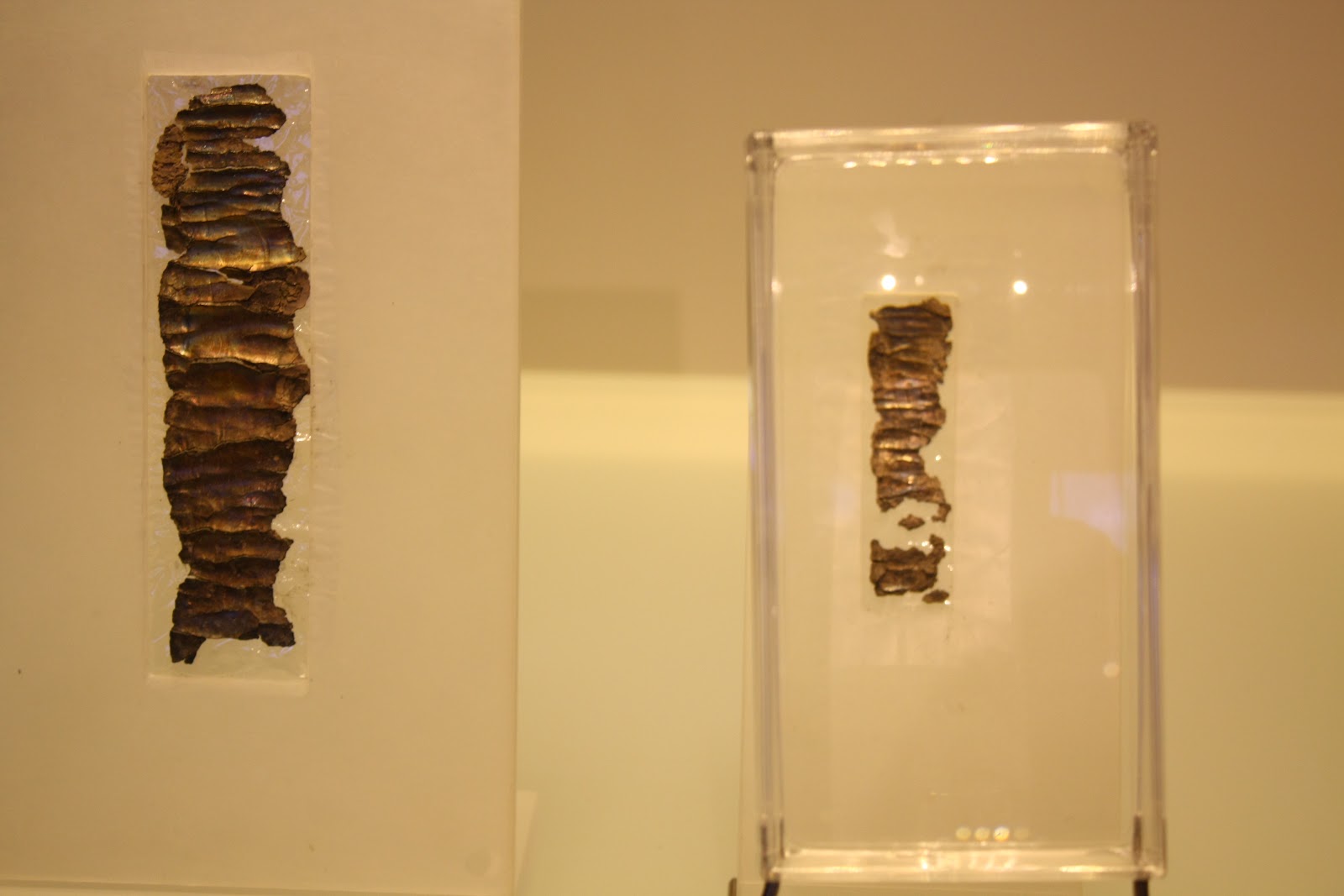
There were many archaeological finds that excited my interest, but perhaps one of the coolest to finally see was this one:
I know it doesn't look like much, but it was found just across the valley from JUC at Ketef Hinnom by my very own archaeology professor, Dr. Gabi Barkai.  These two small silver scrolls contain the oldest known text of Hebrew scripture (the priestly blessing from Numbers 6)- considerably older than the Dead Sea scrolls.  

One of the prettiest displays was the ancient glass room.  I especially liked that little bottle on the bottom.  So brilliantly colored.

There are other wings to the museum, aside from the all important ancient history/archaeology wing.  There's sections for Africa, Asia, the Pacific Islands, and the Americas.  Yes.  I came all the way from Montana where there ARE American Indians to see this display in Israel about American Indians.

We finished off the visit with a look around the Second Temple Model of Jerusalem (which I HAD seen before).  See that wall in the picture below?  The section with two towers and then, a little ways down, a small gate?  That's where JUC is now.  If my understanding is correct, our office is actually on top of the remains of one of those towers.  And the remains of that gate, possibly the gate of the Essene, those remains are in our cemetery.  As you can see the Temple and other important remains in the background, you can get a feeling for how close to everything we are here.

I'll try not to bore you with any more details of pottery and statues and swords and arrowheads and...  Yeah, very cool stuff.  Come visit me and I'll show you. :)


Wednesday, November 4, 2009

A Day in the Life of a JUC Grad Student

Disclaimer: While all of these events are unlikely to occur on any ONE given day, they are things that I am likely to see or experience at any given time.

1. Walking to school in the rain. Up hill. Both ways. Not even exaggerating. Oh how I hope it snows this winter!

2. Night-time field studies to the Israel Museum. This includes
a. Catching a taxi near the school with three other people, trying to haggle for a decent price, and hopefully managing to end up at the Israel Museum by 6pm
b. Once the whole class trickles in, in groups of four, entering the museum (at least the part that is open) and the proceeding to stand and/or sit outside for well over an hour. Fortunately it had stopped raining. Still cold.
c. Looking at the Second Temple period model of Jerusalem. It is a pretty sweet model, I have to say.
d. Reading about odd Rabbinical-type-people. Like Choni the circle-drawer. Or about the disagreements of Shammai and Hillel.
e. Sitting inside in warm, comfortable chairs, and watching an interesting movie about the community at Qumran. And by interesting I don't really mean "informative" but more "rather odd."
f. Going inside the Shrine of the Book and seeing artifacts from Qumran, including several Dead Sea Scroll fragments.
g. Trying to catch another taxi home...walking to the bottom of the hill to try to find one that will give us a better price...and saving maybe 12 NIS in the end, in exchange for walking further.
h. Gathering my things from school, and then walking home. Up hill. At least it wasn't raining, and the walk did warm me up.

3. Playing board games as part of my upper level graduate class...
...Yeah, I suppose I should explain this. For this week, we were each assigned a country or region (Edom, Moab, Ammon, Syria, Phoenicia, Israel, Judah, Philistia, and (my region) the raiders of the Greater Negev). We were to research sort of the political and economic type pressures and desires of our area during the 9th century BC. What was their resource base? What were they trying to gain? Who were they trying to trade with? Who would be natural enemies and who would be natural allies? All that sort of thing. In class we laid things out on the map and talked about what DID happen during the 9th century and why, as well as what COULD have happened (and maybe did happen during a different time period).

4. Watching beautiful sunsets from the roof of a building built on the remains of a tower from the Hasmonean period.

5. Trying to take care of and keep track of several visitors coming and going and coming again in my flat...and also trying to keep track of the coming and going of my flatmates.

6. Cooking. Lots of cooking. Including experimenting with new-to-me foods, such as quinoa and kohlrabi.

And that's all for tonight! Tune in next week for more adventures in the life of a JUC Grad Student! *cue music*

Thursday, January 29, 2009

The Rockefeller Museum

I finally got to go to the Rockefeller Museum today. I've been wanting to go for ages but just didn't have the time last semester. Admission is free right now, I believe because the Israel Museum is close (or partially closed) so that was nice.

It's a beautiful building.
James Leslie Starkey, the excavator at Lachish, was on his way to the opening of this museum almost exactly 70 years ago, when he was murdered. That's a sad story. He is also buried in our back yard.

Probably the best part of the visit (or one of the best) was when we walked into the first room in the musuem. It had a variety of items from a variety of times, but almost the first think I saw was sort of a crown-like circle of bronze. And I said to myself, "Hey, that looks like the crown-like things from the Chalcolithic period that they found in that cave in the Judean Wilderness." And then I looked at the information card near it, and it was. So that was pretty cool. :) I always enjoy recognizing things we've talked about in class. A lot of the remains were from the Persian, Helenistic, and Roman times, and later. I haven't learned much about those (yet) so I wasn't quite as interested, but they also had some good stuff from the Chalcolithic, Bronze, and Iron Ages, so I enjoyed those. They had some good examples of Tell el-Yehudiah ware that I enjoyed. I also liked seeing some Egyptians remains from Beth Shean. Hopefully I'll be able to visit it again some time.

We weren't allowed to take pictures in the Museum, but I did get a picture of the courtyard (for Katie)
and of some bright red flowers with purple-blue centers that were outside in the parking lot area.

There is also a library in the museum which had amazing ancient warnings against book theives posted which I will attempt to reproduce here for your edification. :)

1. He who fears Anu, Enlil, and Ea will return [this book] to the owner's house the same day.
2. He who fears Anu and Antu will return [this book] to the owner's house the next day.
3. He who fears Marduk and Sarpanitum will not entrust [this book] to [others'] hands.
4. He who entrusts [this book] to [others'] hands, may all the gods who are found in Babylon curse him!
5. He who fears Anu and Antu will take care of [this book] and respect it!
6. This book by order of Anu and Antu is to remain in good condition.
7. In the name of Nabu and Marduk, do not rub out the text!
8. Who rubs out the text, Marduk will look upon him in anger.
9. He who fears Anu and Antu will not carry [this book] off by theft.
10. He who carries [this book] off, may Shamash carry off his eyes.
11. He who carries [this book] off, may Adad and Shala carry him off!
12. He who breaks [this book] or puts it in water or rubs it until you cannot recognize it [and] cannot make it be understood, may Ashur, Sin, Shamash, Adad, Ishtar, Bel, Nergal, Ishtar of Nineveh, Ishtar of Arbela, Ishtar of Bit Kidmurri, the gods of heaven and earth and the gods of Assyria, may all these curse him with a curses which cannot be relieved, terrible and merciless, as long as he lives, may they let his name, his seed, be carried off from the land, may they put his flesh in a dog's mouth.

So there you go, don't steal library books!

Saturday, November 8, 2008

The Joys of Museums

Today, a few of us finally made the effort to go to one of the nearby museums that has been recommended numerous times. Specifically, we went to the Pontifical Biblical Institute Museum, near the King David Hotel. It turns out that they're not generally open on Saturday, but they let us in anyway, and we even got a personal tour from Father Maurice Gilbert. It was pretty sweet. It's a small place (2 rooms, one small and one larger), but it has quite a few fairly famous pieces, as well as various archaeological remains from all time periods and from all over this region. I think I may have mentioned before how exciting it is to see things that you've learned about in class. Some of the artifacts they have we've heard mentioned in several classes numerous times, which just adds to the excitement. Many of the remains are from Teleilat Ghassul, a chalcolithic site NE of the Dead Sea, which was excavated from 1921-1929 by Jesuit Monks. Possibly the most spectacular things they found there were frescoes, beautifully preserved, on the walls of a couple buildings. Unfortunately, almost as soon as they were uncovered, they crumbled to dust. They did manage to make a replica, though, which is at the museum we visited. (There was more than one painting, as I understand, but this is probably the most famous.)

This is a fenestrated basalt pedestal. I don't recall where this one was found, but in archaeology we learned about them in conection with the Chalcolithic period around Beersheva. Of course, since Basalt is only found in the north of the country, this means that they had some level of trade going on.

Just yesterday in archaeology we talked about how during the Middle Bronze Age is was apparently very common to bury infants in large jars underneath the floor of the house. Rooms from this time have been found with up to 10 burials in the floor. We don't really know why. It's possible that there was a really high infant mortality rates and they wanted to keep the remains of the child close to home so they were in some sense still part of the family. We also know that there were times and places where human sacrifice was practiced and its possible that at least some of these infants were victims of that horrendous practice. The picture below is of a simliar infant burial from the Chalcolithic Age, found at Teleilat Ghassul.

These are connical pottery vessels from the Chalcholithic Period called "cornettes," generally considered to be drinking glasses.


These are just some cool looking figures. I don't know much about them. Quite a few of the things in the museum were also found in Egypt (maybe at Elephantine?), and these may have been among them.
Tell el-Yehudiyah ware! The first examples of this type of pottery were found at Tel el-Yehudiyah ("Mound of the Jews") in the Nile Delta by none other than Flinders Petrie. It's an interesting site for many reasons which I will not go into at this point. At any rate, this type of pottery actually originated in Palestine, but is still named after the first place it was found. It's generally dark in color, usually jugs or juglets (though occasionally shaped as animals or even people), and decorated with "holes" to form a pattern. One theory is that the jugs, which are thought to have held perfume, were shaped to imitate the fruit from whence the perfume came.


So, that was an example of the delights I experienced this morning. Facinating, isn't it? :)