Something that I have found to be true in my own life is that just about any adventure you have can be, in some form or another, related to one or more of the Chronicles of Narnia (or to one of C. S. Lewis' other books). On my lastest adventure I was accompanied by a fellow adventurer who loves Lewis almost as much as I do, and it was not uncommon for references to be made to the books and similarities pointed out. For your literary enjoyment, I will point out a few of those similarities here.
They struck inland and up a fairly steep, though low, hill. At the top, of course, they looked back, and there was the Dawn Treader shining like a great bright insect and crawling slowly northwestward with her oars. Then they went over the ridge and could see her no longer.
Doorn now lay before them, divided from Felimath by a channel about a mile wide; behind it and to the left lay Arva. The little white town of Narrowhaven on Doorn was easily seen.
~The Voyage of the Dawn Treader, Chapter 3
When one spends time on a sailboat, one cannot help but draw comparisons to the Dawn Treader. We felt, as Lucy, the delight of being on shore again after a few days on the boat - though the solid ground did feel funny. I even like to imagine that Lewis modeled some of his islands after the Greek Islands: grassy hills, more goats than people (on some), white towns, and from the tops of those hills, a view of our boat, shining in the harbor. We failed to meet pirates, sea-serpents, or dragons, but we did experience stormy weather, a damaged boat, and limited water rations.
I had been wandering for hours in similar mean streets, always in the rain and always in evening twilight. Time seemed to have paused on that dismal moment when only a few shops have lit up and it is not yet dark enough for their windows to look cheering. And just as the evening never advanced to night, so my walking had never brought me to the better parts of the town. However far I went I found only dingy lodging houses, small tabacconists, hoardings from which posters hung in rags, windowless warehouses, goods stations without trains, and bookshops of the sort that sell The Works of Aristotle. I never met anyone.
~The Great Divorce, Chapter 1
"How did you like Athens?" has been a common question over the past month or so since I left Athens. The best answer I've found is a comparison I made while there: it reminds me of the grey town in The Great Divorce. The historical sites are great, but the modern town itself... It's kind of dirty, covered with graffiti, the streets go on an on, each with a few of the same little dingy shops open (but more places closed than open), and as far as you walk, nothing changes, and you never get to a better part of town. It's not eternally raining and not eternally twilight, but apart from that, the description fits pretty well.
At first Shasta could see nothing in the valley below him but a sea of mist with a few domes and pinnacles rising from it; but as the light increased and the mist cleared away, he saw more and more. A broad river divided itself into two streams and on the island between them stood the city of Tashbaan, one of the wonders of the world. Round the very edge of the island, so that the water lapped against the stone, ran high walls strengthened with so many towers that he soon gave up trying to count them. Inside the walls the island rose in a hill, and every bit of that hill, up to the Tisroc's palace and the great temple of Tash at the top, was completely covered in buildings: terrace above terrace, street above street, zigzag roads or huge flights of steps bordered with orange trees and lemon trees, roof gardens, balconies, deep archways, pillared colonnades, spires, battlements, minarets, pinnacles. And when at last the sun rose out of the sea and the great silver-plated dome of the temple flashed back its light, he was almost dazzled.
~The Horse and His Boy, Chapter 4
Apparently Lewis modeled Calormen after Turkey. I have to say that I liked Turkey quite a lot, while no one, probably not even Calormens, like Calormen. That aside, similarities can still be seen, and this discription of Tashbaan sounds a lot like what I imagine the Golden Horn of Istanbul was like during the time of the Ottomans. A walled hill, surrounded by water (not quite an island), topped by Topkapi palace and mosques instead of the temple.
It is also worth noting that "aslan" is the Turkish word for "lion" and thus it was not uncommon to come across places like "Aslan Tourism" or "Aslan Cafe."
But it was a queer city. The lights were so few and far apart that they would hardly have done for scattered cottages in our world. But the little bits of the place which you could see by the lights were like glimpses of a great seaport. You could make out in one place a whole crowd of ships loading or unloading; in another, bales of stuff and warehouses; in a third, walls and pillars that suggested great palaces or temples; and always, wherever the light fell, endless crowds: hundreds of Earthmen....The City was as quiet, and nearly as dark, as the inside of an anthill.
~The Silver Chair, Chapter 10
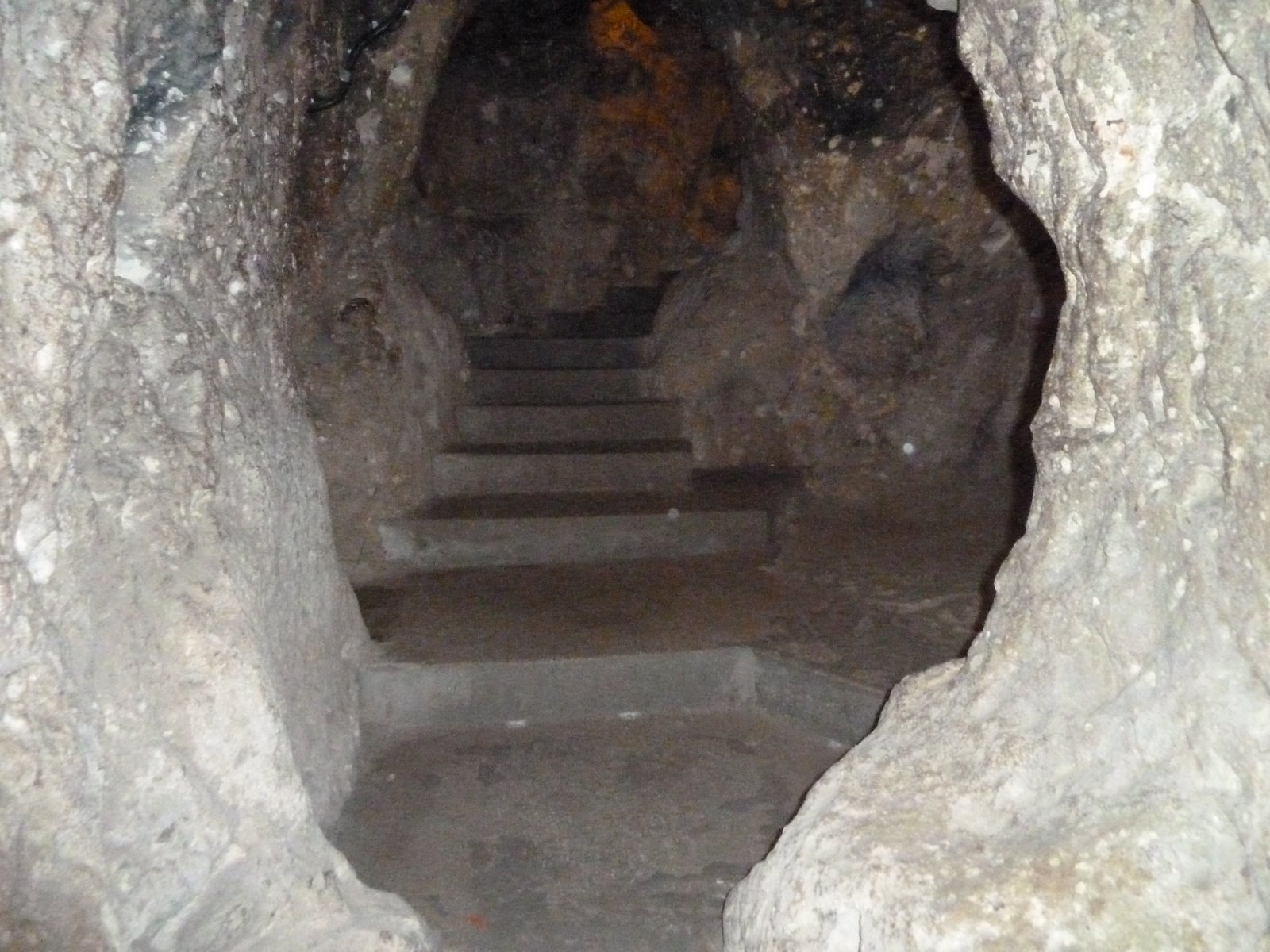
The underground city we visited in Cappadocia was nothing like the one described here, being merely a series of tunnels, rooms, and passage ways - nothing like a cave large enough to contain a whole city. Still, one could get a sense of what a relief it must have been for Jill, Eustace, Puddleglum, and Rilian to find themselves above ground, free to move and breath, rejoicing in the light of the sun and moon. Apparently there are around 100 such underground cities all around that region of Turkey. It's hard to imagine that many people living that deep underground, buried alive with all their animals, self-sufficient in their caves for long enough to avoid whatever enemies troubled them.
Pressing their way between the laden branches they reached the wall. It was very old, and broken down in places, with moss and wallflowers growing on it, but it was higher than all but the tallest trees. And when they came quite close to it they found a great arch which must once have had a gate in it but was not almost filled up with the largest of all the apple trees. They had to break some of the branches to get past, and when they had done so they all blinked because the daylight became suddenly much brighter. They found themselves in a wide open place with walls all around it. In here there were no trees, only level grass and daisies, and ivy, and gray walls. It was a bright, secret, quiet place, and rather sad; and all four stepped out into the middle of it, glad to be able to straighten their backs and move their limbs freely.
~Prince Caspian, Chapter 1
Visiting the ruins at Olympos felt almost as if we'd stumbled upon the ruins of Cair Paravel. The sun soaked stones, overgrown with trees and vines, stood near the sea, abandoned and unused for centuries. We kept expecting to find a treasure room and have to rescue a dwarf from some hostile Telmarines. Instead, the most threatening creature we came across was a large toad.
Tirian looked and saw the queerest and most ridiculous thing you can imagine. Only a few yards away, clear to be seen in the sunlight, there stood up a rough wooden door, and round it, the framework of the doorway: nothing else, no walls, no roof. He waled toward it, bewildered, and the others followed, watching to see what he would do. He walked round to the other side of the door. But it looked just the same from the other side: he was still in the open air, on a summer morning. The door was simply standing up by itself as if it had grown there like a tree.
~The Last Battle, Chapter 13
Here and there, wandering around ancient ruins, one will happen across something like this: the walls and ceiling crumbled away years ago, but the doorway is still standing (though usually not with a door still hung in it). Though you know it doesn't go anywhere, it's hard not to imagine that it might be a door to other worlds - maybe even to Aslan's country!